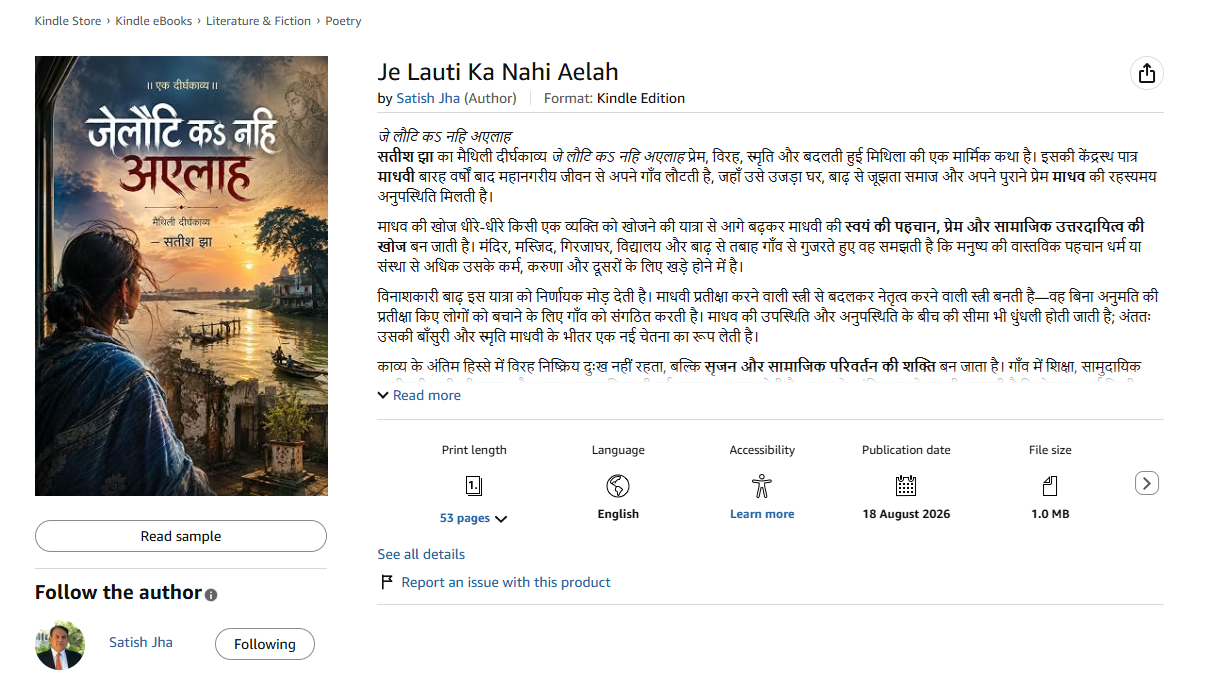
NEW DELHI, DELHI, INDIA, August 20, 2026 /EINPresswire.com/ — Satish Jha’s New Maithili Long Poem Reimagines Loss, Migration and Return in a Changing Mithila
Je Lauti K’ Nahi Aelaah transforms the classical language of separation into a contemporary meditation on those who left—and the world they left behind
Je Lauti K’ Nahi Aelaah (“They Who Never Returned”), a major new Maithili long poem by poet, journalist and public thinker Satish Jha, brings the inherited poetic imagination of Mithila into urgent conversation with the realities of the twenty-first century.
The poem speaks of those who departed but never truly returned: migrants who left their villages, families separated by necessity, memories displaced by modernity, and generations whose relationship with their ancestral world has grown increasingly fragile.
Moving through villages transformed by migration, floods, neglected schools, disappearing ponds, concrete cities and digital loneliness, Je Lauti K’ Nahi Aelaah begins with absence and gradually enlarges it into a collective condition. What has disappeared is not merely a group of people. It is also a way of belonging—to language, landscape, community and shared moral responsibility.
Written as a multi-part poetic journey, the work draws upon Maithili’s profound tradition of love and virah while decisively expanding its scope. Separation here is not limited to the distance between lovers. It encompasses the migrant’s separation from home, the child’s separation from inherited memory, society’s separation from nature and the growing distance between public institutions and the people they were created to serve.
The poem’s imaginative ancestry reaches back to Vidyapati’s lyric intensity while engaging the socially grounded modernity associated with Nagarjun and Rajkamal Chaudhary. Its language remains rooted in the soil, speech and cultural memory of Mithila, but its concerns are unmistakably contemporary: ecological devastation in the Kosi region, displacement, women’s agency, bureaucratic failure, religious coexistence, fractured education, diaspora responsibility and the possibility of rebuilding public trust.
Among the poem’s most striking passages are scenes of interfaith relief, damaged landscapes, children encountering a different kind of school, and communities attempting to recover what migration and modern life have scattered. Its “Panchayat of Love” is not offered as sentimental reconciliation. It becomes an ethical institution—a place where memory must answer to action and private grief must acquire a public purpose.
“The poem asks what return can mean when the people, villages and relationships we remember no longer exist in their earlier form,” Jha said. “It suggests that return is not simply a journey back to a place. It is the recovery of our responsibility toward one another.”
The title’s “they” is deliberately capacious. It includes those who left in search of work and dignity; those lost to floods, poverty or social neglect; those absorbed into distant cities and countries; and those who remained physically present but became estranged from their language, history or community.
Those who never returned nevertheless remain active presences in the poem. Their absence shapes the consciousness of those who stayed behind. It becomes a moral question addressed equally to the village, the city, the state and the diaspora: what do the living owe to the people and places from which their present lives emerged?
With Je Lauti K’ Nahi Aelaah, Jha attempts an ambitious reconstruction of the Maithili long poem. The work retains the intimacy, musicality and cultural inheritance of the language while extending its reach into civic, ecological and philosophical territory. It is at once a poem of Mithila and a wider meditation on what societies lose when development becomes severed from memory, belonging and care.
About Satish Jha
Satish Jha is a poet, journalist, entrepreneur and public-policy thinker whose work spans Maithili, Hindi, Urdu and English. He imagined and visualized Jansatta and persuaded Ramnath Goenka, the legendary founder of the Indian Express Group, to launch the Hindi daily in 1983. He later served as editor of Dinamaan. His literary work explores memory, migration, education, social responsibility, civilizational continuity and the moral consequences of institutional failure. His major poetic works include Janma Sa Pahine (Before Birth), Damodar Thakurak Ena, Darar Me Ujas and Matik Smriti (The Memory of Soil).
Media and Review Copies
For interviews, review copies, publication information or permissions, please contact:
[Name] – Girish Jha
[Organisation or Publisher] – Maithili Sahitya Prakashan
[Email] – ceoxef@gmail.com
[Telephone] – +91 99100 22922
[Website] – https://www.maithilisahitya.com/
Abbinav Gupta
Vidya Bharati Foundation of America
+91 99100 22922
email us here
Visit us on social media:
LinkedIn
Legal Disclaimer:
EIN Presswire provides this news content “as is” without warranty of any kind. We do not accept any responsibility or liability
for the accuracy, content, images, videos, licenses, completeness, legality, or reliability of the information contained in this
article. If you have any complaints or copyright issues related to this article, kindly contact the author above.

Media gallery